
Nicole Day: Why Endurance is the Ultimate Form of Mental Wellness
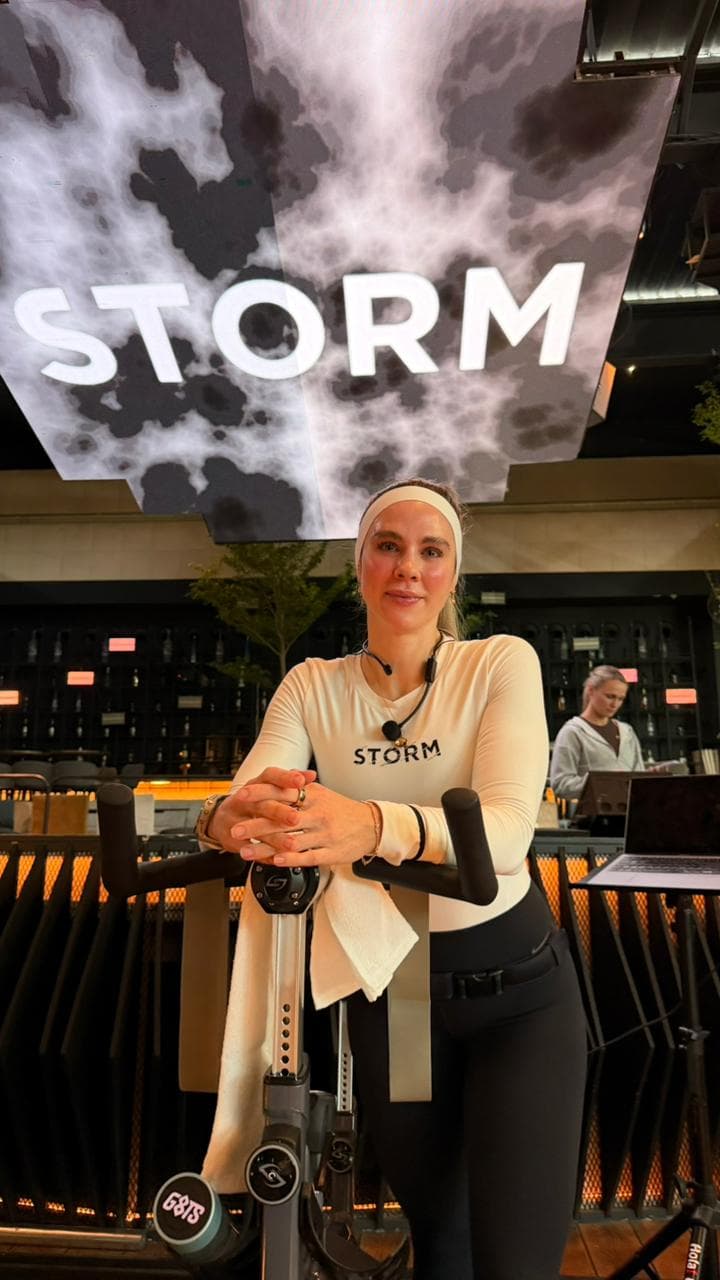
Nicole didn’t walk into Storm Cycling looking for a new career. She walked in as a client: a mother who, by her own account, had spent years quietly surviving rather than living. Today she’s the studio’s head coach, and also a certified life coach, model and public speaker who has taught a class at the Forbes 30/50 summit, given a 60-minute talk on fulfilment at an ophthalmology conference in Abu Dhabi, and appeared on Dubai Sports TV.
Her competition list reads like a dare: Hyrox in Abu Dhabi and Mumbai, Tough Mudder, a 100km desert run. But what sets Nicole apart isn’t how much she’s done. It’s how honestly she talks about what it cost. She has run a 5K the day after a miscarriage, rebuilt her life after divorce, and refuses to pretend that “doing it all” comes free.
We spoke to her about sacrifice, grief, why she’s given up on balance, and what she wants every woman she coaches to walk away with.

1. You’ve gone from being a client at Storm Cycling to head coach, while also becoming a certified life coach, model, and public speaker. Take us back to the beginning: who was Nicole before all of this, and what was the moment that changed everything?
Before all of this, I was a woman who was surviving quietly.From the outside, my life made sense. I was a mother, I was functioning, I was doing what needed to be done. But internally, I was disconnected from my own voice. I had learned how to endure, not how to choose myself. There wasn’t one dramatic moment that changed everything. It was a quiet realization that kept getting
louder, I can’t keep living a life where I’m absent from
it.
Storm Cycling wasn’t just where I trained it was where something in me woke up again. Strength. Presence. Ownership. That’s where the shift began. Not when my life changed, but when I decided I was no longer willing to stay the same.
2. You’ve stacked certifications, competed in endurance races, and built a career, all while being a mother. Society loves to romanticize ‘doing it all,’ but you’ve been honest about sacrifice. What are you actually sacrificing, and why do you think there’s still a stigma when women name that out loud?
I’ve sacrificed comfort. I’ve sacrificed being understood. I’ve sacrificed time, energy, and sometimes the version of me that just wanted things to be easier. There are days whenI’m exhausted. Days where I question if I’m getting it right. Days where being strong isn’t inspiring, it’s necessary. But the stigma exists because honesty disrupts the narrative. People want the outcome without the truth behind it. The truth is, you can have more but it will cost you something. And the moment women start owning that cost without shame, everything changes.
3. You ran a 5K competition the day after experiencing a miscarriage while navigating a double pregnancy. Most people would call that unimaginable. What was going through your mind that day, and what do you want women to take from that story?
That day wasn’t about strength the way people imagine it. It wasn’t inspiring in the moment. It was heavy and it was confusing. I was grieving and moving at the same time. But what stayed with me is that I didn’t disconnect from myself.
I didn’t shut down. I didn’t pretend it wasn’t happening. I carried it with me and that’s what I want women to understand, resilience isn’t about ignoring pain. It’s about not abandoning yourself inside of it. You don’t have to be perfect in your hardest moments. You just have to stay with yourself.
4. Your divorce became a turning point rather than just a painful chapter. What’s the one thing you wish someone had told you, and what do you tell the women sitting across from you now?
I wish someone had told me that the end of something doesn’t mean you’ve failed, it means you’ve finally stopped betraying yourself. For a long time, I thought strength meant holding everything together. Now I know it also means knowing when to let it fall apart.
What I tell the women I work with now is this. You don’t rebuild your life by waiting to feel ready. You rebuild it by making decisions your future self would thank you for, even when your present self is scared. Your power isn’t gone, it’s just been buried under everything you’ve tolerated.
5. From Hyrox Abu Dhabi and Mumbai to Tough Mudder to a 100km desert run, your competition list is something most people never attempt. What does pushing your body to those limits do for your mind, and how does it connect to your work as a coach?
When you push your body to its limits, you run out of excuses. There’s a moment where your mind starts negotiating, telling you to stop, to slow down, to stay safe. And then you realize… you don’t have to listen. That’s what training has given me. Not just endurance, but authority over my own mind. It’s taught me that discomfort isn’t danger. It’s expansion.
And that’s the message I carry into my coaching. Most women aren’t lacking capability, they’re just listening to a version of themselves that was built in fear.
6. You’ve said, “One woman can spark a change, multiple women can leave an everlasting impact.” That philosophy took you to the Forbes 30/50 summit. What did being in that room mean to you, and how has it shaped how you show up for the women you coach?
Teaching that class that day wasn’t about validation, it was about recognition. I looked around and saw women who had built, led, created… and I realized there’s no single way to be powerful. It wasn’t about fitting into that space. It was about understanding that I already belonged in it.
And that changed how I show up now. I don’t coach from a place of “you’ll get there one day.” I coach from a place of, “You are already more capable than you’ve allowed yourself to believe. ”
7. You delivered a 60-minute talk on work-life balance and fulfillment at an ophthalmology conference in Abu Dhabi, and were also interviewed on Dubai Sports TV. Across both, you challenge the idea of balance, reframing it as “life funding fulfillment.” What’s the difference, and why does that distinction matter?
Balance suggests everything should feel equal. But life doesn’t work like that. There are seasons where things are aligned, and seasons where they’re not. Periods where one area demands more than another. What matters isn’t balance, it’s intention. I don’t chase balance. I build a life that funds what fulfills me. That means my work supports my purpose, my choices support my growth, and even the difficult seasons are moving me somewhere meaningful. It shifts you from managing your life… to leading it.
8. You’ve said what fuels you is the drive to leave an impact. When you picture the version of Nicole who has achieved everything she set out to do, what does she look like, and what do you hope the women who’ve crossed your path carry forward?
She’s a woman who didn’t abandon herself. She made decisions that were hard, uncomfortable, and sometimes misunderstood, but they were hers. She created spaces where women felt seen, challenged, and capable of more. And if I’ve done this right, the women who’ve crossed my path won’t remember me for what I said. They’ll remember who they became after encountering me. More honest. More certain. More willing to choose themselves. Because at the end of everything… that’s the impact. Not that I inspired them, but that they realized they never needed permission to become who they were meant to be.


