
The Business of Living Better: Why the UAE Is Leading the GCC's Longevity Boom
With 2,200 longevity organisations and more than 21,000 health and wellness businesses, the UAE is emerging as the Gulf's leading hub for an industry increasingly focused on helping people live healthier and longer lives.

What does the future of health look like when the goal is no longer simply to treat illness, but to prevent it, slow the ageing process and help people enjoy more years in good health? Across the UAE, that future is already taking shape, and it is becoming a rather sizeable industry.
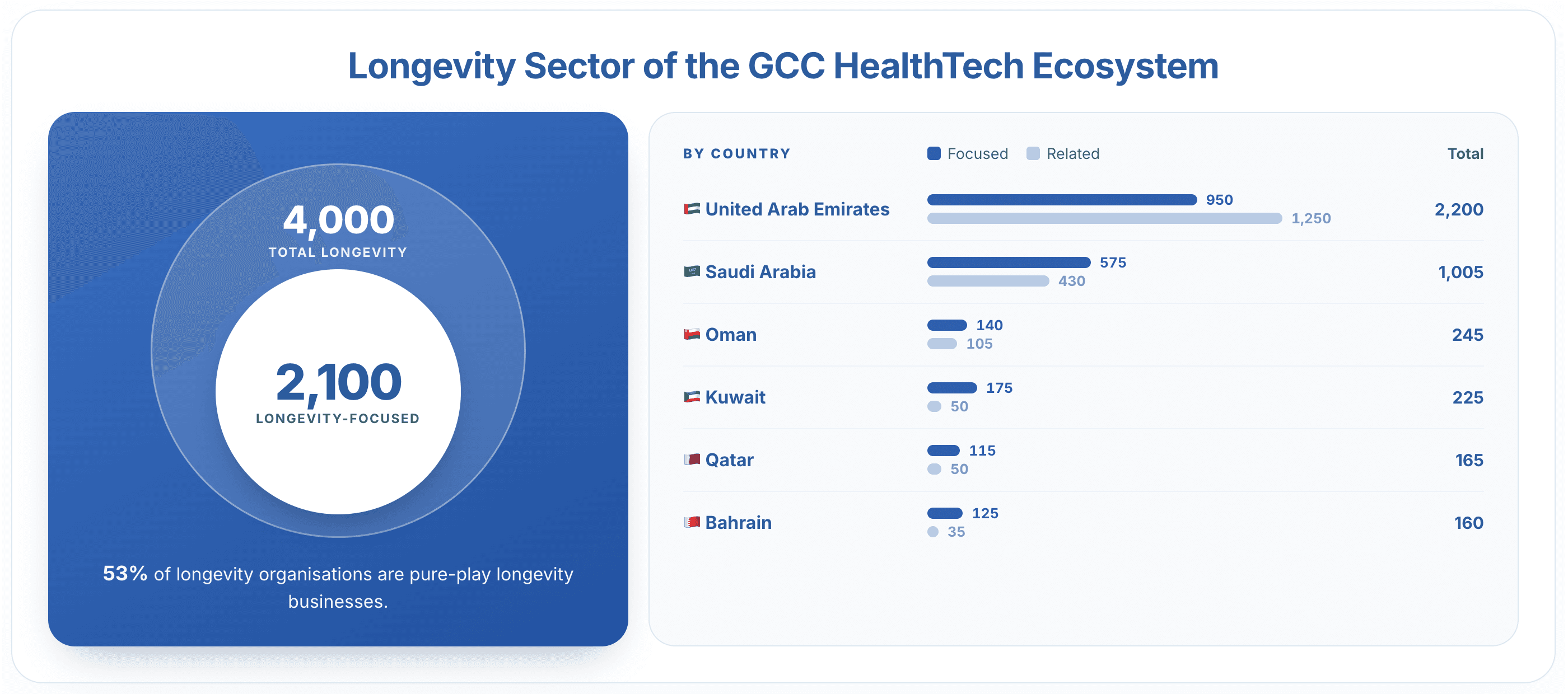
New findings from the GCC HealthTech & Wellness ecosystem platform, launched by Gulf Longevity Intelligence Group and Longevity Industry Analytics, reveal that the UAE is home to 2,200 longevity organisations, representing 55 per cent of the 4,000 identified across the six Gulf Cooperation Council (GCC) countries. In other words, more than half of the region's longevity ecosystem is concentrated in one country.
The findings offer an interesting snapshot of just how quickly the conversation around longevity is moving beyond niche medical circles and into the wider health and wellness economy. From specialised longevity clinics and digital health companies to fitness studios, medical aesthetics providers and wellness centres, the industry is becoming increasingly interconnected.
Across Saudi Arabia, the UAE, Qatar, Kuwait, Oman and Bahrain, the platform maps 60,000 organisations operating across HealthTech, healthcare, wellness and fitness. The UAE accounts for 21,158 of these, making it the largest national ecosystem in the region. More significantly, longevity organisations represent 10 per cent of the country's health and wellness sector, compared with a GCC-wide average of 6.6 per cent.
Of the UAE's 2,200 longevity organisations, 950 are classified as longevity-focused, while another 1,250 are longevity-related. This distinction is important. Longevity is not an industry confined to clinics offering advanced diagnostics or regenerative treatments. It also encompasses the businesses, technologies and services contributing to healthier lifestyles, preventive care and longer-term wellbeing.
The Expanding Longevity Economy
One of the more interesting aspects of the research is the scale of the wider wellness economy, much of which operates beyond traditional healthcare settings.
Of the 60,000 organisations mapped across the GCC, approximately 49,000 fall within the wellness and fitness category. This includes 5,753 wellness and spa businesses, highlighting how much of the region's health economy is built around the places where people actively engage with their wellbeing.
The wider database also identifies 10,403 organisations in fitness and sports, 9,775 in pharmaceuticals and medical businesses, and 8,277 in beauty and aesthetics. Meanwhile, 2,389 companies operate in digital health, data and artificial intelligence.
Together, these figures reveal an industry that extends far beyond medical appointments and hospital visits. It includes the fitness facilities where people build strength, the wellness centres where they seek recovery, the aesthetics clinics investing in skin health and the technology companies developing new ways to monitor and manage personal health.
As Dmitry Kaminskiy, General Partner of Deep Knowledge Group, explains: "It is often the case that the clinical side of this sector gets measured and the consumer side does not." He points out that gyms, spas, fitness operators and wellness centres are where many people actually interact with their own health.
It is an important distinction, particularly as the concept of longevity becomes more mainstream. Living longer is one part of the conversation; maintaining physical function, supporting mental wellbeing and preserving quality of life along the way are equally significant.
Why the UAE Is Attracting the Longevity Industry
The UAE's growing concentration of longevity organisations reflects the combination of clinical infrastructure, private-sector investment and an established consumer wellness market.
The country has also started bringing longevity medicine into more formal healthcare frameworks. In January 2025, the Department of Health – Abu Dhabi licensed Pura Longevity Clinic under its framework for healthy longevity medicine centres, marking a step towards the regulation of specialised longevity services.
Dubai's healthcare sector is expanding too. According to the Dubai Health Authority, the number of licensed healthcare facilities reached approximately 5,800 in 2025, compared with 5,340 in 2024.
For Kaminskiy, the opportunity lies in connecting the clinical and consumer sides of the industry, rather than treating wellness as something entirely separate from the healthcare system.
That convergence could become particularly important as preventive health gains greater attention. It also creates opportunities for businesses working across diagnostics, personalised health services, fitness, recovery and digital health to collaborate more closely.
Mapping the Future of Health
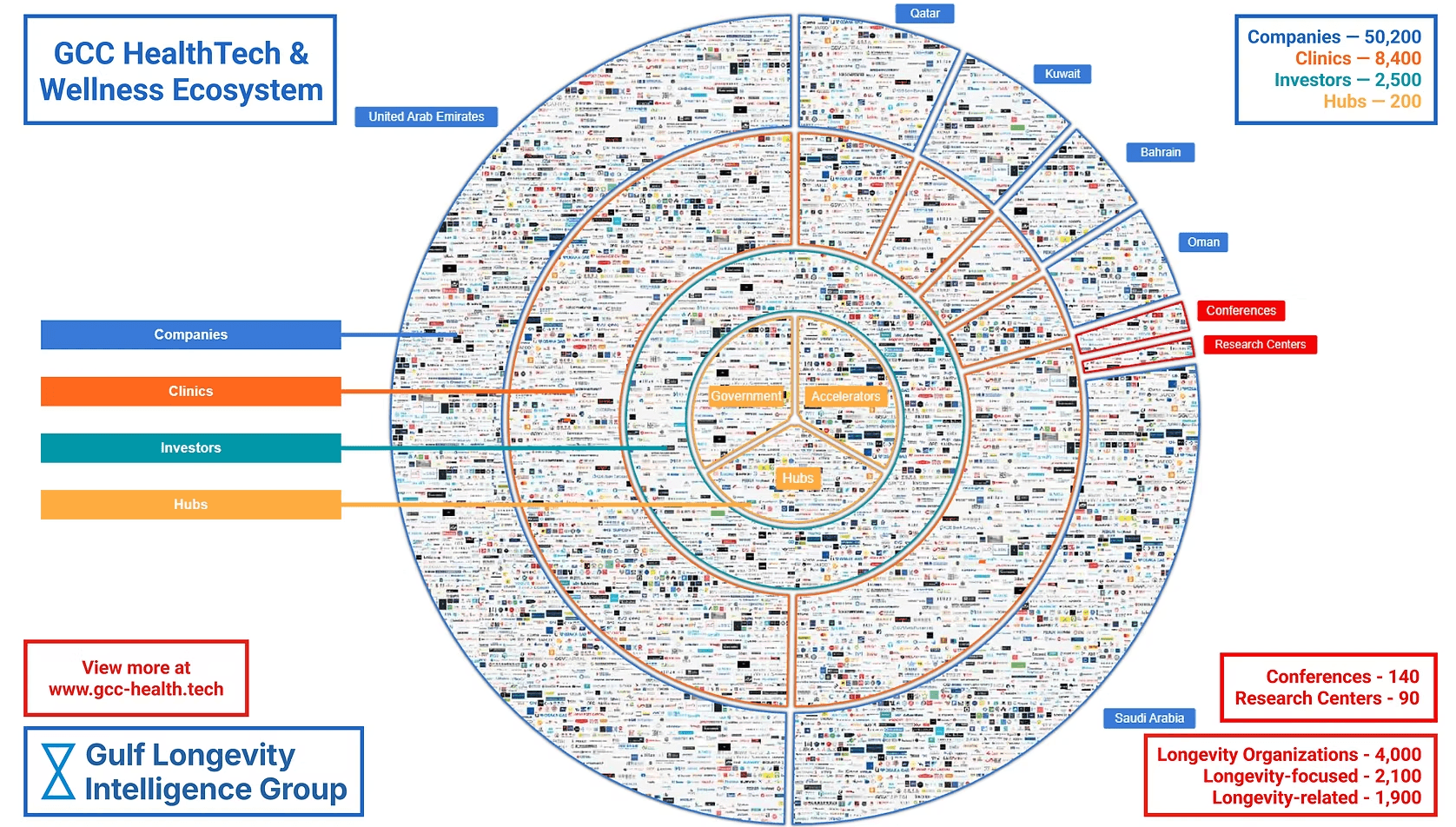
Beyond identifying organisations, the newly launched GCC HealthTech & Wellness platform aims to make the regional ecosystem easier to navigate. Developed with technological support from Deep Knowledge Group, it brings together a database, interactive dashboard, leaders map and 3D visualisation covering all six GCC markets.
It also looks at the investment landscape behind the industry's expansion. The platform identifies 2,515 investors active across the regional sector, including 1,050 venture funds, alongside 96 government programmes and 90 research centres.
For founders, investors and healthcare operators, this information offers a way to identify potential partners, understand market activity and explore opportunities across different countries. Rather than relying solely on broad market estimates, users can examine individual organisations, their activities and their geographical distribution.
Karim Saleh, Business Development Manager at Deep Knowledge Group, highlights the practical value of this approach, explaining how a diagnostics company entering the UAE market could use the database to identify potential clinic partners and understand the existing suppliers serving them.
Ultimately, the numbers tell a story that goes beyond the size of the UAE's longevity market. They reveal an increasingly connected ecosystem in which healthcare, technology, fitness and wellness are beginning to intersect in new ways.
The next chapter of longevity will not be written by clinics alone. It will involve the scientists developing new approaches to health, the entrepreneurs building technologies, the investors supporting innovation and the wellness businesses helping people make healthier choices every day.
With 2,200 longevity organisations already operating in the UAE, the foundations are firmly taking shape. The bigger question now is how effectively this growing ecosystem can turn its momentum into something that matters most: more healthy years, better quality of life and a future in which wellbeing becomes an integral part of how we live, not simply something we seek when our health begins to falter.


